
Baking Soda vs Baking Powder: The Difference That Ruins or Saves Your Bake
Mix up baking soda and baking powder and your bake is flat, metallic, or bitter. Here's the real difference, when each is needed, and why some recipes use both.
Baking soda and baking powder look almost identical and live next to each other in the cupboard, which is exactly why they get swapped by accident. The results are not subtle: the wrong one can leave a cake flat, give cookies a metallic soapy taste, or make a muffin bitter. The fix is knowing what each actually is and why a recipe asks for it.
Baking soda: needs acid to work
Baking soda is a single thing — sodium bicarbonate, a base. It only leavens when it meets an acid and heat. The acid can be buttermilk, yogurt, lemon juice, vinegar, molasses, brown sugar, or cocoa. The reaction releases carbon dioxide immediately (the moment the wet hits the dry), so you bake soda batters fast — they don't wait.
Because it's strong, a little goes far, and too much leaves a soapy, metallic taste. If a recipe has baking soda but no obvious acid, there's usually a hidden one — don't remove it.
Baking powder: contains its own acid
Baking powder is baking soda plus a built-in acid, so it leavens with just water and heat. Most is "double-acting": one lift when the wet hits the dry, and a second lift in the oven's heat. That second lift is why batters using baking powder can sit a little before baking — a luxury soda batters don't have.
Why some recipes use both
When a batter is acidic (lots of buttermilk, say), baking soda neutralizes some of that acid and gives a quick first lift, while baking powder supplies the extra rise the acid-heavy batter needs on its own. Using both is a deliberate balance, not indecision. Don't swap one for the other in those recipes.
Can you substitute?
- Baking powder for baking soda: yes, roughly — use about 3× the baking powder (it's mostly filler), and reduce other salt slightly. Works because baking powder contains soda plus acid.
- Baking soda for baking powder: only if you add an acid. Use 1/3 the amount of soda plus enough acid (like cream of tartar or lemon juice) to react. Get this wrong and you taste it.
- When in doubt, follow the recipe exactly. Baking is chemistry; ratios are not flexible the way savory cooking is. Use the unit converter for scaling a recipe's quantities, but never change the soda/powder ratio without understanding why.
Are yours still good?
Both lose potency over time. Test baking soda with a splash of vinegar — it should fizz vigorously. Test baking powder with hot water — it should bubble. Dead leavening is the silent cause of flat bakes, and it's usually the first thing to check when a trusted recipe suddenly fails.
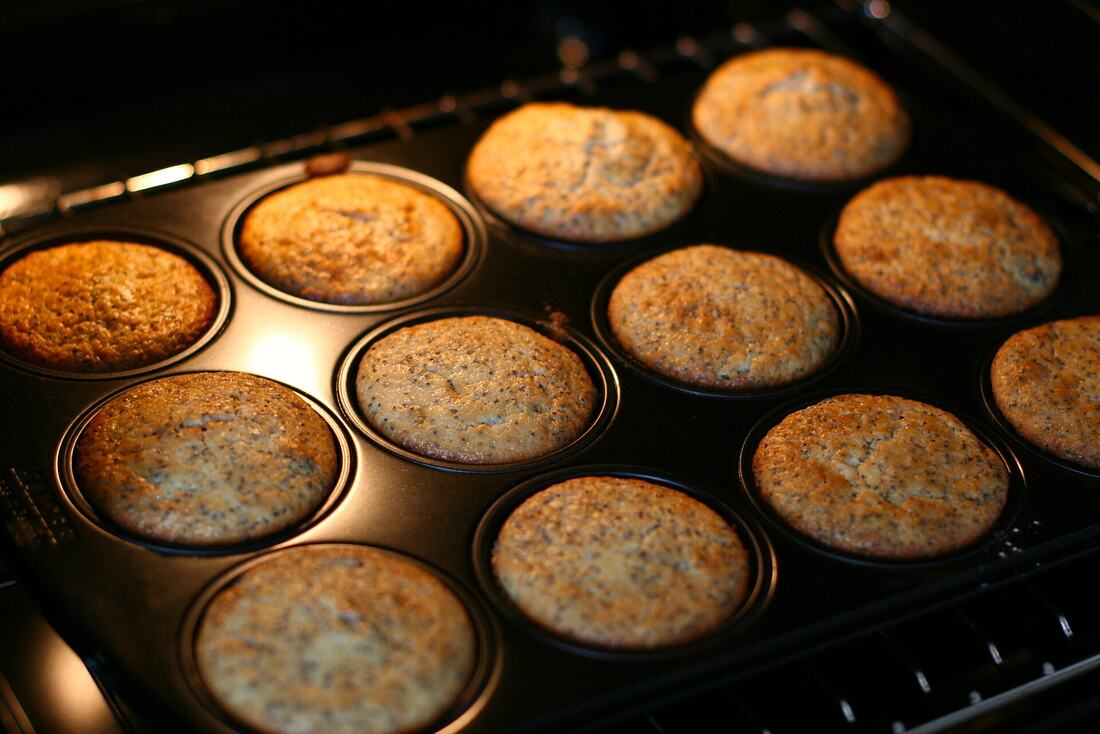
Photo: Cranberry-Mohn muffins in a baking tray, Wikimedia Commons (CC BY-SA 2.0).