
Wet Brining, Explained: The Science of Salt Water (with Calculator)
A wet brine is just salt water — but the strength and timing decide whether your chicken is juicy or mushy. Here's the science and a calculator that does the math.
A wet brine is the simplest recipe in cooking: salt, water, and time. Yet it is also the most misunderstood. Too weak and nothing happens. Too strong or too long and you get salty, mushy meat that nobody wants. The difference between a brine that transforms a chicken and one that ruins it is entirely in the numbers — and those numbers are easy to get right once you understand what is actually happening inside the meat.
What a brine actually does
Salt dissolved in water does two jobs. First, it seasons from the inside: the salt diffuses into the meat over time, so the flavor is not just on the surface. Second, and more important, salt partially dissolves some of the muscle proteins (mostly myosin). Those dissolved proteins form a loose gel that holds water more effectively, so when you cook the meat, less moisture squeezes out. That is why brined chicken survives a few extra degrees of doneness without turning to sawdust.
It is not osmosis pushing water in — that popular explanation is wrong. Water movement into the meat is real but modest; the brining magic is mostly the protein gel holding on to what is already there.
Wet brine vs dry brine
- Wet brine (salt dissolved in water): adds a little extra moisture and seasons evenly. Great for lean meats and anything cooked hot and fast.
- Dry brine (salt rubbed on the surface): pulls moisture out, then that salty liquid re-diffuses in. Less water to manage, and the drier surface gives noticeably crisper skin on roast chicken.
Neither is "better" — they are different tools. If crisp skin is the goal, dry-brine. If you want the maximum forgiveness on a lean cut, wet-brine.
Strength and time: the two numbers that matter
Brine strength is expressed as a percentage of salt to water: a 5% brine is 50 g of salt per litre of water. The everyday range is 3–6%. Under 2% and you are barely seasoning; over 8–10% is pickle territory and needs a short, precise window.
The second number is time, and it is inversely related to strength: a stronger brine needs less time. A chicken breast in 5% brine is done in under an hour; in a 2% brine it needs several hours to do anything at all.
Try it — set the protein, strength, and volume:
The calculator uses the 5%-brine baselines and scales them for whatever strength you choose, so you never have to memorize a table.
Three mistakes that ruin brines
- Brining pre-brined meat. Supermarket chicken is often injected with sodium solution. Brining it again is a double dose — check the label.
- Brining too long. The protein gel is great until it isn't: over-brined meat turns soft, translucent, and almost cured. Set a timer, not a vague memory.
- Skipping the pat-dry. After the brine, the surface is wet. A wet surface steams instead of browning — pat it completely dry before it touches the pan.
The key takeaway: a wet brine is a protein gel, not a water injection. Salt concentration controls how fast it works; time controls how far it goes. 5% brine, correct time, pat dry, and the rest is normal cooking.
For seasoning technique beyond brining, see how to salt food properly, and for exact cook temperatures by protein, the Cooking Reference has the numbers. Not sure whether a cut is worth brining? Ask the chef — a one-line question is free.
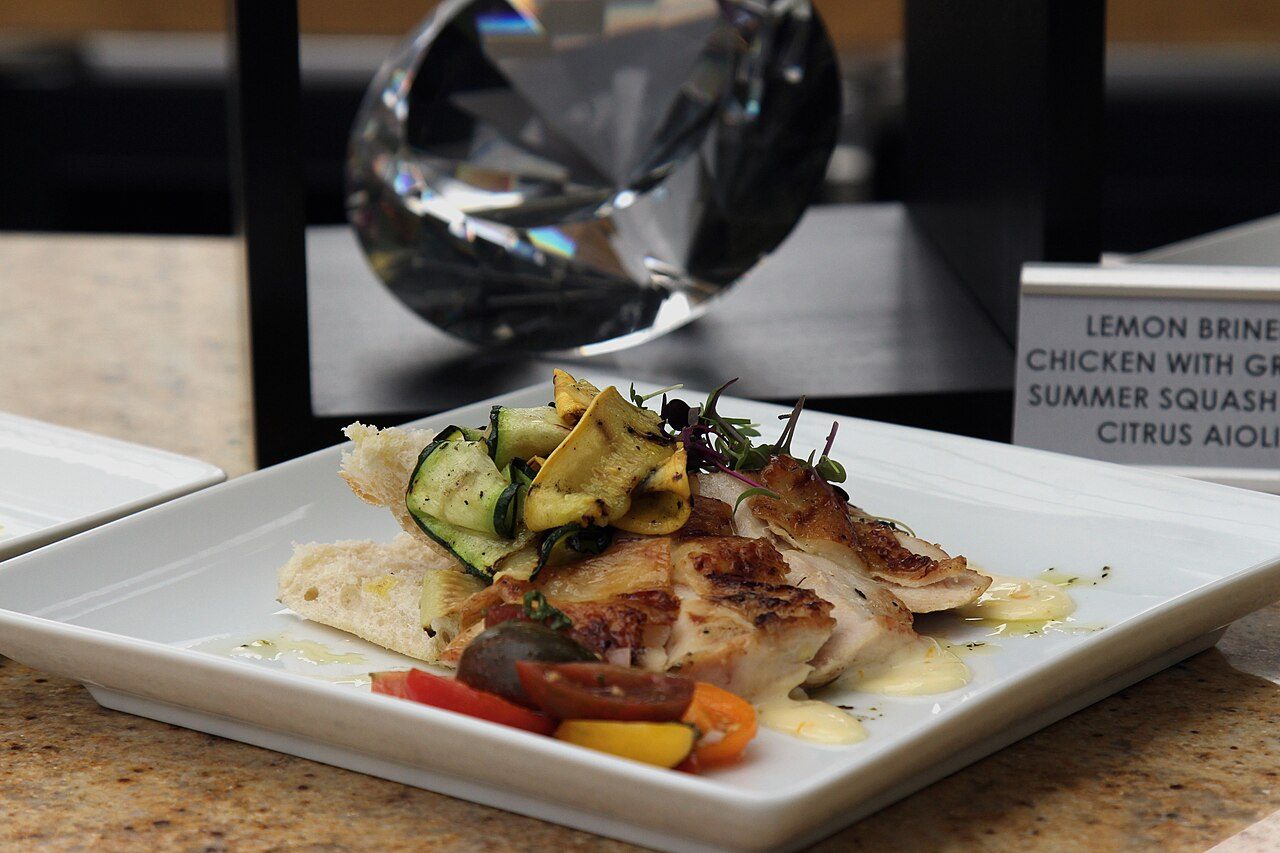
Photo: Lemon-brined roast chicken by Prayitno, Wikimedia Commons (CC BY 2.0).